Thank you, Ljubica!

I went to Idaho to visit my parents for Christmas. I did not stay in Chicago because Ljubica had the kids for almost the entire break (December 23–January 3). I also had not seen my parents in a year, and, well, quite frankly the entire past year sucked. I needed to get away from Chicago.

Anyway, I took the train there and back. I arrived back in Chicago on December 29. I had to leave the next morning to visit a friend in New England. My train was scheduled to arrive in Chicago at 3:12 PM on the 29th—ample time to take the kids out for dinner—if Ljubica were to be willing to allow me to see them. (It was her day.)

So I sent her an email: “Ljubica, if I get home early enough, I would like to take the kids out to dinner on Thursday night.” Unfortunately, my train was eight hours late. I did not get home until 11:40 PM. Even if Ljubica had said yes (she didn’t) to taking the kids out to dinner, it would not have worked out. I sent her a follow-up email, “Never mind. My train is 8 hours late; I won’t be able to take the kids out.”

I got home. I went to bed. I got up early. I went to the airport. I flew to Boston.

Agnes called me on Friday. “Dad,” she asked, “when are you going to pick Ivan and me up to go out for dinner? Mom said you were taking us out tonight….”

Thank you, Ljubica, for lying to our daughter. Thank you for misleading her. Thank you for setting me up to disappoint her.

I get the kids tomorrow at 9:00 AM. I haven’t seen them in ten days—the result of Ljubica’s request to have the kids over Christmas and New Year—ostensibly to visit family in Bosnia. We arranged and agreed on the dates in mid-November. My last email on the subject stated, “I will have the children from 9:00 AM on January 3…. Are we in agreement?” Her response: “yes.”

So Ljubica went and set up a playdate with Agnes’s friend for tomorrow. Agnes called. She spoke with uncertainty in her voice, “Dad, are you getting us tomorrow…?” (I’d been telling her for days that I’d see her on Tuesday.) “Yes,” I said. “Well…,” her voice trailed off. “Mom made a playdate for me for tomorrow with one of my friends, but I guess it’s okay if I don’t go….” The disappointment in her voice was palpable.

I didn’t know what to say. I told her I would call her back. Then I phoned her friend’s mother, who didn’t answer, and then her father, who also didn’t answer. I left a message: “This is Agnes’s dad. There’s been a misunderstanding. Apparently, Ljubica set up a playdate for our daughters for tomorrow, but tomorrow is my day with the kids. I can still bring Agnes over, though. Just let me know.”

I called Agnes back. “Hi beautiful! I left a message with your friend’s dad. I’m waiting to hear back from him. Maybe you can still see your friend tomorrow.” Agnes’s voice perked up. She seemed glad that she might still see her friend.

Then Ljubica got on the phone. “What are you doing calling her friend’s dad? You don’t need to do that! You don’t need to call anyone. And it’s your fault, anyway. I can just reschedule the playdate for Saturday, when I have the kids. And besides, there never was a playdate planned for tomorrow. Agnes misunderstood. She overheard me talking to her friend’s mom. She didn’t know what was going on. So don’t call anyone. Okay? You don’t need to talk to those people.”

Thank you again, Ljubica, for lying to our daughter. Thank you for misleading her. Thank you for setting me up to disappoint her.

Oh, and you’re welcome for that time in November when I let you take Agnes out all night so that you could go to that ethnic festival with her—even though it was my day.

Oh, and you’re welcome for that time in December when I let you take Agnes out all afternoon so that you could take her to the ballet—even though that was my day, too.

Anniversary

Tonight is an anniversary. A year ago, on December 19, after we had all watched a movie together and the kids had gone to bed, Ljubica and I stayed up. It was a Saturday night. She wanted to talk with me. Rather, she wanted to talk at me. I stayed up with her until 1:30 AM.

The content of her speech was simple: she was divorcing me. Why? Because marrying me had been a mistake. Because we couldn’t do anything together. Because I made her have sex with me. Because she would never subject herself to be again. Because she would never submit herself to me again. Because she wanted her own home with her own rules and her own language. Because she did not want to be my wife. Because I was worse than a child molester. Because I was worse than a rapist.

I protested. “It’s not true,” I said, “that we can’t do anything together.” “We can work this out,” I pleaded. “Let’s get counseling,” I begged. “Let’s try something we’ve never tried—let’s ask professionals to help us.”

“No,” she responded. She had made up her mind. Our marriage was over.

I went to bed. She didn’t come. Maybe she slept in our daughter’s room. Maybe she didn’t sleep at all.

The sun came up. The kids woke up. Agnes and I went to church. Ivan didn’t come. Was he sick? I can’t remember. Probably he just didn’t feel like coming. Probably I didn’t want to risk an argument with Ljubica by insisting that he come.

After church Agnes and I went shopping for Christmas presents for Ljubica. We went to Ross and bought her a new pair of shoes. They were the kind that have memory foam in the soles. They were designed to keep one’s feet comfortable all day.

(I’d never bought Ljubica a new pair of shoes before. She wouldn’t let me. And in thirteen years of marriage, I don’t think she ever even bought herself a new pair of shoes, either. Not because we didn’t have money. She could have bought a new pair of shoes whenever she wanted. But she never did.)

Nice shoes and other nice things from Ross. For Christmas. For her. The day after she told me that she had decided to divorce me.

Sunday night repeated Saturday night. We watched another movie. The kids went to bed. Ljubica and I sat in the living room. She seated herself in the same dark brown upholstered chair that she had occupied the night before. I call it the shit chair now. Ljubica sat in the shit chair and shit on our marriage. I sat on the couch and tried to find a way to clean up the shit.

“I promise not to ask you to have sex with me again,” I pleaded. “I promise….” “Let’s….” “I love you….” “We can….” “Let’s try….” I recycled my ragged entreaties like a worn-out beggar. Nothing worked. Nothing ever had. “No,” she said, again. It was over, she said. Never again would she subject herself to me. Never. I went to bed at 1:30 AM. She didn’t come. Maybe she slept in our son’s room. Maybe she didn’t sleep at all.

Still, I’d bought her Christmas presents: a nice pair of shoes and other nice things from Ross.

A Bent Wire

My father is an engineer. I was an inquisitive child. My father outdid himself answering my questions. The result: I know stuff about things that many people do not know.

For instance, did you know that you can break a wire by bending it repeatedly? The reason is metal fatigue. At a microscopic level the wire begins to fracture. As the wire is repeatedly stressed by being bent, these fractures grow until the wire finally breaks into two pieces.

I would sometimes do this to coat hangers if I needed a short piece of wire for something but couldn’t find wire cutters or another suitable tool. I would grip the wire and bend it back and forth, back and forth, back and forth, until the wire broke.

My marriage was like a wire. I was on one end; Ljubica was on the other. Our relationship was strung between us. How strong was that wire? It does not matter. The weakest, puniest wire will never break if it is never stressed. The highest quality steel beam will fracture if it is subjected to enough stress. Drive enough cars over the Golden Gate Bridge and it too will fall.

Metal fatigue is insidious. Its effects are often invisible until the metal fails. This is why engineers are cautious: suspecting that a beam might be near failure is enough to warrant replacing it. No one wants a bridge full of commuters anxious to get home to fall down.

I-5 Bridge Collapse Commerce
Collapsed bridge on I-5

The wire that was my marriage was subjected to incredible loads. Ljubica bent it back and forth, back and forth, back and forth, over a period of years. She bent it out of shape within months of our wedding when she said, “I shouldn’t have married you.” No season went by without her bending it.

Ljubica never permitted anyone to see her bending the wire. (Except me. I couldn’t not see her.) To casual observers, the wire was always straight. They never saw the tangled mess that it could be.

And then the wire broke. It broke suddenly a year ago. “You raped me,” she accused me. “You raped me on our wedding night,” she indicted me. “I’m leaving you,” she declared. SNAP. The end seemed sudden. It came out of nowhere. “Where did this come from?” friends opined. “Your marriage seemed so perfect,” they cried.

But the specialists knew. The psychologists, therapists, psychiatrists, counselors, and spiritual directors understood. The myriad of unobservable microfractures had caused the marriage to fail. The end was sudden but not unexpected. Stress a marriage enough and it will fail.

He that has ears to hear, let him hear (Matt 11:15).

Sleep

It took me four hours to fall asleep last night.

Once upon a time, I could fall asleep by just putting my head on my pillow. When I was married to Ljubica and her mistreatment was especially severe, I would sometimes have a hard time falling asleep. I would lie in bed angry, frustrated, or simply despondent. I would occupy the narrowest sliver of the mattress, nearest the edge of my side of the bed, and try to sleep. Thoughts would race through my head. “Doesn’t she know that I love her?” “Why is she treating me this way.” Sometimes I would despair of life and dread what the morning might bring. Often I would long simply to reach out to her, to hold her in my arms, or even to hold her hand. To know that she was there, that somehow I was accepted, that somehow I was still hers. But I didn’t move. And I couldn’t sleep.

Sometimes I would get out of bed and lie on the floor in the living room. Then I would get cold, go back to bed, and reoccupy my place on the edge. Sometimes I would get up and drink a glass of wine or even a shot of whiskey to hasten sleep. And next to me would lie she-who-cannot-be-touched.

It took me four hours to fall asleep last night. I tossed and I turned. I changed positions. I tried everything but sleep would not come. My mind was a torrent of untamed thoughts filled with the past year’s haunting pain and horror.

When we were together, in order to cope with her abuse, I learned to forget her mistreatment of me but remember my own failures. I believed the lie that I am bad but she is good, that I am unreasonable but she is reasonable. I learned to forget her abuse. “What she did wasn’t so bad,” I would tell myself. But mostly I tried not to think about it at all. Even today my mind mitigate her abuse while accentuating my own faults. “Maybe you were wrong, maybe you were wrong, maybe you were wrong,” it tells me. “Maybe I need to ask her to forgive me. Maybe I need to seek reconciliation. Maybe I need to repent…,” my mind says. “Maybe we need to get back together…,” I think. Or something inside of me thinks. Is it from within or without? Whose voice is it, really?

Sleep does not come. The wall behind which hide the memories of her abuse cracks and crumbles. I am flooded by memories of mistreatment. I am waylaid. I am cut open and my guts spill out. I recall all the times she left without leaving, left without leaving, left without leaving. The times she denied my love, denied my love, denied my love. “You don’t love me, you don’t love me, you don’t love me,” she says. “I’m leaving you; I’ve left you; you’re nothing to me; you’re nothing more than a pile of cow shit to me.” I feel the weight of her words on my soul. My heart is encased in stone. It struggles to beat against the calcified deposits of dismissive and hateful words.

“Reconciliation?” I think. I would rather be dead. I told our minister once, “Nothing terrifies me more than the prospect of being married to Ljubica.” It was true then, and it is still true. I would rather die. Fear makes my body tremble.

Sleep still does not come….

Thanksgiving

Here is a picture of the first Thanksgiving dinner I made for my family. It was 2012.

thanksgiving_2012

I had been gone the previous weekend for a conference but returned home in time for Thanksgiving. We had never made Thanksgiving dinner ourselves before. That year no one had invited us for the holiday, we were far from family, and besides, I wanted to try my hand at making a turkey (breast, in this case).

As is evident from the picture, it was a modest affair: turkey, corn, green beans, mashed potatoes and gravy, and bread of some sort. I hope there was desert but no evidence of it remains in the picture.

There is also no evidence in the picture of the small bottle of juice that I threw across the room and smashed into the wall, splattering it everywhere, after Ljubica left with the kids for the entire morning and afternoon.

Ljubica did not want to have Thanksgiving dinner. She didn’t want to cook. She didn’t want to clean up. It did not matter to her that I wanted to make Thanksgiving dinner, that I had been talking about it for weeks, or that I had bought a turkey. What mattered was that she wanted to take the kids to the park and have pizza. On Thanksgiving Day.

She didn’t cook. She didn’t clean up. She took the kids to the park and had me call her when dinner was ready. No one was home while I made it. No one saw me throw the bottle of juice across the room. No one saw me frantically clean the wall until almost no evidence of my anger remained.

I called. They came home. We offered thanks to God. We ate. I cleaned up.

But there was no joy in it for me. I made my wife eat a meal that she did not want. Even now I don’t know what to think. According to her definition of the word, I was being selfish. In this case, selfishness meant me doing something I wanted to do for my family. To avoid being selfish, all I needed to do was to do whatever she wanted. My marriage was a school for learning how not to want.

Spots remained from the bottle of juice I threw across the room. Ljubica noticed them. “Where did they come from?” she would ask. I never told her. I was too embarrassed. I still am. People I know will read this. They will know that I wrote it. What will they think of a man who can get so angry that he throws a bottle across a room?

I made Thanksgiving dinner last year, too. Ljubica invited two families she knew from the old country. Eight or nine people came to dinner. The centerpiece was a large brined turkey that took six hours to roast. It was beautiful. But Ljubica complained that I had made a turkey. She hadn’t wanted one, she said. She said that I had tricked her into having turkey because I had not reminded her that a year earlier she had said that she did not want to have turkey again for Thanksgiving. One of our guests, a woman, at least scolded her. “You have to have turkey,” she said. “It’s Thanksgiving.”

Now we are divorced. I have the kids this year for Thanksgiving. Yesterday they baked with me. We made two pies. We had a great time.

Last year’s guests will not be coming. The friends and acquaintances we had in common are now exclusively hers. She made sure of that. So I invited homeless people for dinner: Vince and his wife Marsha and Bob and his wife Kim.

We will give thanks with them.

I love you, in protest

We humans have a way of speaking to one another in conventional ways. Someone says, “how are you?” and the other person responds, “I’m fine. How are you?” “Have a great day” is met with “you too.” “Good morning” is reciprocated in kind.

Someone once said that such pleasantries are grease for human relationships. They enable us to foster good will for one another.

I like to “I-love-you” the people I love. I say it to my children several times a day. When I drop them off at school, I say, “Have a good day. I love you!” When they go to bed, I say, “Sleep well, and I love you.”

My children know how to respond to me saying, “I love you.” They say, “I love you, too.”

“I love you, too.” It is such a simple thing to say.

I liked to say “I love you” to Ljubica, too. I would say it to her in her own language. (We always spoke her language.) I have to believe that once upon a time in our relationship, she, too, would reflexively respond to my “I love you” with “I love you, too.” It is difficult to recall times when this happened, however, because at some point she stopped saying “I love you” and “I love you, too.”

Instead, she would grunt. “I love you, Ljubica.” Grunt.

“I love you.”

Grunt.

“I love you.”

Grunt.

Once she told me to stop saying “I love you” to her. She said that the words “I love you” hurt her.

Sometimes she would respond to me saying “I love you” by saying “I don’t love you.”

“I love you.”

“I don’t love you.”

“I love you.”

“I don’t love you.”

I wanted to hear the words “I love you” from her. I almost never did.

But I kept saying “I love you.”

“I love you, I love you, I love you.”

Grunt. “I don’t love you.” Grunt. “Stop saying you love me.”

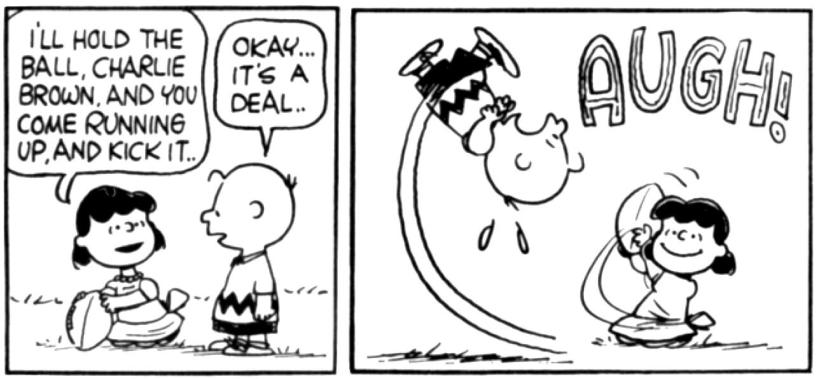
I told my therapist about it. He likened me to Charlie Brown in Peanuts. Lucy would put the football down for him to kick only to snatch it away at the last second so that Charlie would miss the ball and fall onto the ground. Charlie was surprised every time.

cb

“I love you.” Bam.

My therapist asked me why I kept doing it. He suggested that I stop saying “I love you” to Ljubica for my own sanity. He wondered why I would keep saying “I love you” to Ljubica. Didn’t I know, he wondered, how she would respond?

Of course I did.

I knew.

Charlie maybe didn’t know what was in store for him, but I did. I always did.

“I love you.”

Grunt.

I told my therapist that I kept saying “I love you” to Ljubica in protest. It was my way of protesting her dismissal of my love. It was my way of protesting her lack of love for me. My “I love you” meant “I love you anyway” or “I love you even though….”

“…even though you treat me worse than you treat anyone else.”

“…even though you denigrate our marriage.”

“…even though you hate me.”

“…even though your behavior squeezes life out of my soul.”

“…even though…”

Ljubica, I loved you. I did. Even in protest.

No longer.

Halloween

My kids hit the Halloween jackpot. After three years of only marginal returns, after striking out at the mall a year ago, after vainly walking the streets of our neighborhood two years ago, this Monday they struck chocolate. The street has a name, but I will simply call it Sugar Alley. With decorations to rival Christmas, house after house beckoned trick-or-treaters with enough sugar to make cavities sufficient to turn around a failing dental practice. My kids came home with eight pounds of candy—128 ounces—enough to fill my largest mixing bowl to overflowing.

Halloween was a resounding success—almost. My son wanted to go by Ljubica’s house to get candy. He knew that she would not be there; apparently she was babysitting somewhere. But she had told him that she would leave candy out for him and his sister in a plastic pumpkin. When we got to her house, the candy stash had been raided and no candy remained. When Ivan saw that there was no candy from his mom, his lip began to quiver and started crying. He then began berating the “rude children” who had taken all of the candy. He said that he would not become a person like that—someone who would take so much candy that others would not have any. I couldn’t help but be proud of him despite his disappointment.

This Halloween marked the first holiday that Ljubica and I were not together with our kids. She was conspicuously absent on our walk. It was strange because it was different. I felt both her absence and no desire to have her there. It felt odd.

Halloween, like many holidays, was often difficult with Ljubica. One Halloween was decidedly unpleasant. I cannot remember all of the details; I think that we were not sure about where to go candy-hunting. We tried one place, maybe the mall, but they were out of candy. On the way home, I thought of stopping at the house of one of my professors. He lived nearby and I thought that he would be a safe bet. I parked the car and walked up to the house with the kids. No one was home. Then I remembered that some of my classmates lived next door. They were a kind of neo-monastic group. Six or seven people lived there. Two were women. One was married and sharing, obviously, a room with her husband. The other, Lara, was single. So we walked over to their house. No one was home except Lara and another member of the community, Randy. They didn’t have any candy, but they did give the kids an apple each.

The kids took their apples and we walked back to the car. We got in and Ljubica let me know why I had chosen that house: According to her, I was in love with Lara and wanted the kids to meet my girlfriend. (As it happens, Lara and Randy were in love with each other. They are now married and have a beautiful baby boy.) The kids got apples; I got accused of adultery.

This happened years ago—maybe as many as five or six. Why mention it at all? Why bring it up? Because I remembered it while we were out trick-or-treating. And also because the accusation never went away. This past summer Ljubica began writing me derogatory missives and leaving them on our dining room table. One was a list of women with whom she accused me of having affairs. Lara’s name was on the list along with eight others.

I never had an affair with any of them. I never had an affair with anyone. I never betrayed by vow.

Words that Make and Unmake

In the Catholic Church, the parties to the marriage effect the marriage. The bride and groom’s consent enacts the sacrament. The words of promise spoken by the man and the woman bring about the bond of matrimony. The priest who performs the wedding is only a witness who stands alongside other to testify to what those who are becoming husband and wife are creating.

The Catholic Church also teaches that sexual cooperation open to the creation of new life is likewise an intrinsic part of any understanding of marriage. In fact, the pope reserves the right to nullify a non-consummated marriage even if the consent of the parties to the marriage is valid.

Words make a marriage: “You are my wife; I am your husband.” “You are my husband; I am your wife.” Sex makes a marriage. These are not the only ingredients, of course, and alone it is difficult to image words and sex making a successful marriage, but they are fundamental.

Words and sex make a marriage. In canon law, the fact that the right words have been spoken and the fact of sexual cooperation create the presumption that a marriage is valid. For a marriage to be declared invalid, this presumption must be overcome.

My former minister wrote:

I’m aware that Ljubica has at various times stated her desire to not be married to you, or her regret at having married you…. I have no doubt that such words cause great pain and severely undermine the foundation of a marriage , perhaps irreparably…. I don’t agree that words and actions like those necessarily, by the fact that they happen, end a marriage.

Let’s review my former spouse’s words and actions. Great detail is not needed. She said, “You are not my husband; I am not your wife.” She said it repeatedly. She said it in a myriad of ways. She said it over the span of many years. She mocked our wedding vows. She called them “a joke” and “meaningless.” She denigrated the witnesses to our wedding, calling them inadequate. She said, “I will never have sex with you again.” She said, “You raped me.” She said, “You raped me on our wedding night.” She said, “You are worse than the man who raped me in college; the only difference between you and him is that you tell me, ‘I love you,’ when you are done.” She said, “You are worse than a child molester.”

If words make a marriage, can they not unmake it? If an action makes a marriage, can an action not unmake it? Words and actions such as Ljubica’s do not “severely undermine the foundation of a marriage”; rather, they directly assault marriage itself. They are the antithesis of marriage. They undo it. They unmake it.

In Islam, if a husband says to his wife once that she is no longer his wife, his words are not effective. They accomplish nothing and he is still married. But once he says it three times, the marriage is over. His words are effective and irrevocable. There can be no reconciliation. I do not pretend to know the underlying theological rationale behind this ordinance, but I want to believe that it is this: Don’t jerk your wife around.

Human relationships need stability. Children need to know that their father is their father—not just when the fathers feel like it, but always. They need to know that their mother is their mother—not just when she wants to be a mother. And husbands and wives need to know that their spouses are their spouses all the time—not just when they feel like it.

There are many legitimate reasons for divorce: drug abuse, alcoholism, infidelity, child abuse, neglect, and abandonment are only a few. But surely the assertion of one spouse to another, “You are not my spouse,” ought to head the list. Drug abuse may “severely undermine the foundation of a marriage,” but the words, “You are not my husband,” destroy it.

Hated

I want my shoulders to stop hurting. I want the pain to go away. I want my level of stress to go down. I do not want to feel attacked any more. I do not want to feel belittled anymore. I do not want to feel condemned any more. I want people to understand. I want my so-called friends to understand. I want them to care. But they care not. They are not my friends. They made choices. They believed lies. They swallowed the falsehood that I am an evil person. They stand on the side of injustice and condemn me. They avoid me. They will not look me in the eye. They think that I raped my wife. They think that I abused her. They think that I hurt her. They think that I harmed her. They do not know the truth. They only see through the distorted lens of her hateful vision. When they see me, they see evil. They greet my children after school but not me. They wave with no enthusiasm and no desire, only going through the motions because my children are present. I only say, “hi.” There is nothing else to say. I remain silent and allow myself to be hated. I am dismissed. They do not think that I loved my wife—but I did. They do not think that I cared about my wife—but I did. They do not know that I served my wife—but I did. They do not know that I supported my wife—but I did. They do not know that I did even when she rejected me, when she hated me, and when she violated me. She is perfect but I am condemned. I am condemned. This is my lament: “They hated me without reason.” Lord Jesus, do you understand? “I do,” he says. “Yes, I do.”

Summer Camps

This past June, Ljubica wanted to talk about our kids attending summer camps. Below, more or less, is the conversation we had. Ultimately, the conversation had little to do with summer camps.


L. I want to take Ivan to an acting class…. I don’t need to think about when I took the kids to school, when I picked them up, when I did something for the kids, when I cooked for them, when I washed their clothes. I’m not asking myself about those things, if you want to know, because I’ve been here and I’m still here.

Me. And where is Ivan going to go to acting class? What’s the place?

L. Second City.

Me. Second City?

L. Uh huh. And I’ll take care of that. You don’t need to interfere in that at all. It’s mine. If I register him, if they have space.

Me. You can take the kids to vacation Bible school.

L. What?

Me. You can take the kids to vacation Bible school, at Living Stone Christian Church, but the kids aren’t going to go to Living Stone on Sundays.

L. When they’re with me, they’ll go.

Me. While we’re together, they’re going to go with me to Jackson Boulevard Christian Church.

L. No. While we’re together, they’re not going to go anywhere. We said so.

Me. No. No, we didn’t say that.

L. Yes, we did. I did it with our lawyers.

Me. No, we didn’t say that. We said that we wouldn’t take the kids to church until after mediation. Mediation is over now.

L. No. We said the kids wouldn’t go to church until everything is finished. I said so.

Me. We didn’t agree on that.

L. Okay. Another phone call, another letter doesn’t cost me anything to write. No, they’re not going to go to Jackson Boulevard because you’re not going to Jackson Boulevard. You’re going to the Catholics. What do you want to take the kids to Jackson Boulevard for?

Me. Because I want to take them to church.

L. Why aren’t you taking them to the Catholics?

Me. Because I…

L. Why aren’t you going to them? No. Yes. Why change to Jackson Boulevard when they when they have one there they have a church.

Me. Yes, they have one. But you wanted to malign me.

L. What about you? What did you do? No, you maligned yourself there, if you want to know. I didn’t malign you at all but you maligned yourself in the way…. They saw how you care for someone, how you treat a person.

Me. What?

L. They saw for themselves how you treated me, the way you went forward and talked in the presence of the children. All of them saw it themselves. I didn’t open my mouth. Go and talk to the preacher, go. I didn’t open my mouth to talk to anyone except Amy and Cathy whom I needed to talk to someone. And you said that I wrote to thirty women in the church, that I maligned you to thirty women. There aren’t thirty women, not even fifteen, if you count them.

Me. You sent an email to all of those women saying that I hurt you every day.

L. To all of those women? What did I know about who was there in the email? Big deal that I sent an email. Who have you sent email to? Can you count the churches in Idaho and in Tennessee…? The kids will either go to Living Stone. While we’re together, they won’t go anywhere at all, anywhere at all. Big deal. They aren’t going to go to Jackson Boulevard right now. And when I’m divorced, then when you have your house and I have mine and when you have the kids during the weekend, I’m not going to get interfere. But the children now no, no. Are they still asking why we’re not going to church? What do they know about Jackson Boulevard? Are you joking? Think about the kids a little bit. Don’t think just about yourself, yourself that I maligned you. You maligned me, too. You maligned me everywhere. But I still went out in front of people. Those people got up and came, both from Living Stone and from Clinton Elementary, those people that you went to saying, “Ooh watch out, watch out because she went crazy.” They came and watched Agnes dance. Why didn’t you call and invite anyone? Who came to support you? Think about the kids a little bit. I mean it. Don’t look at me like that. Think about the kids. Don’t think about me. You don’t have anything to put me out there in…. But think about the kids a little so as not to make it more difficult. And the friendships that they created big deal that you ruined them with someone, big deal that my friendships with who knows who were ruined. I’m not worried about them, about that issue, at all, not at all, if the children’s friendships aren’t ruined. Because not one of the people that you talked to bothered to call me and ask, “How are you?” No one at all. There were just the people that I called to me, to ask them how they’re doing. And the people from Living Stone aren’t calling me, none of them. And I haven’t called anyone either. Why? Because of what you told them. They believed you, your lies; they believed your lies. I don’t need to go to anyone to give testimony, to talk. A joke. I’m telling you: if you want to make it easier—I’m not looking to argue with you because I can see that you don’t care at all; I’ve seen you at these meetings. But, if you want to finish it more quickly and get on with your life, stop being so stiff-necked.

Me. And how do you see this getting resolved?

L. By deciding to not seek to say, “me, me, me, me, me.” And, “you, you there, stay there. I get the kids. I did this. I did that. I found the doctors. I did this. I found the schools.” And where was I? Didn’t I come here from Tennessee—that mistreatment—with you so that you could go to your school and the next day we went to visit schools? But no, I was kicking back relaxing the whole time you were doing that. That mistreatment of moving from Bosnia to go to Tennessee and to Idaho and for all of us to go there. Agnes was born and you weren’t able to give three or four hundred dollars to make my delivery easier. And get on the bus, and I went there, I went there to find on the last day I found the doctor myself. You didn’t find him. I found him, I found him. And in Bosnia I would have found all of them myself if I were there. Don’t make joke at me. Don’t bullshit me because I’m here and I know these things. And I didn’t go, as heavy as I was, to find a doctor. I know a hundred places. And I don’t get stuck. Fortunately, our kids are healthy. They’re not sick. To get them one checkup a year, huh? What is that? They bring doctors to school; they do those things through the school. That’s nothing. What would you do if one of the kids had some kind of disease that demanded taking him there regularly? When did you take our kids to the emergency room or whatever our kids? You’re not joking, are you? Don’t, don’t make it like all these thousands of dollars are being spent for a little, for nothing, for nothing, nothing, nothing at all. I’ve told you from the beginning: for nothing. And now look! You’re fighting to talk to people and are frantic to defend yourself. Will you tell me what I did with these kids, what? Don’t make me think about myself whether I was or wasn’t because I was here and I’m going to be here. And if I have to fight for them for hundreds of years, if God lets me live, I’m going to fight. Because you don’t know what it is to be a mother. Don’t joke around with me about those things. Don’t obligate me. Fortunately, people are seeing and hearing and helping and helping me and are going to help me. For your own delight. Look at where you want to go for your own selfishness. And I no one is stopping you. No one is stopping you. Go. Go. Get on with your life. But don’t destroy these two kids more. For me—garbage. I was—do you know what I was for you? One of those—what do they call them?—a paper cup. That’s how much you … me—a paper cup that you lose, that you throw on the street. Or maybe you never used it and just threw it out. It got covered up with dust there. I’m not going to let my kids be like that. I’m not fighting to to gain that care of yours for me and whatever. Not at all. And take notes and surely you’re recording. Record. I don’t care. I don’t care. Take your phone. Hold it like that. Enough. Enough. I’m not ashamed to look you in the eye. I’m not ashamed at all. Because I remained faithful the whole time. Those small promises that I gave you—if I gave them to you—I kept them. Think about yourself and ask what what you did to me. Okay? Like that. Wait for when I fall down on the ground. Just wait for when you can say, “Look, she fell, she fell down. Didn’t I tell you?” That’s it? That’s love for a person, for a “sister in Christ” and things that you, you call? Just to wait for when a person falls on the ground? Are you going to count up how many minutes I’ve spent talking? Count them. Sigh. I don’t know.

Me. To say…

L. Do you know what? It’s hard for me to lay eyes on you. Hard. I don’t want to sit at the table and eat with you. I feel like… I feel like throwing up with I see you, if you want to know. Know that. And I put up with it like that.